If you’ve recently been told your vehicle needs a windshield calibration after a replacement, you’re probably wondering whether it’s really necessary—or if it’s just another added expense.
At Vision Glass Toronto, we believe in giving our customers honest answers. Here’s what you need to know.
Do All Vehicles Need a Windshield Calibration after replacement?
No.
Calibration is only required on vehicles equipped with Advanced Driver Assistance Systems (ADAS). These systems rely on cameras or sensors that are often mounted behind the windshield. They power important safety features such as:
- Lane Departure Warning
- Lane Keep Assist
- Forward Collision Warning
- Automatic Emergency Braking
- Traffic Sign Recognition
- Adaptive Cruise Control
If your vehicle does not have ADAS, there is no calibration required after replacing the windshield.
Our technicians will always verify whether your vehicle requires calibration before recommending the service.
Will My Safety Features Still Work Without a Calibration?
Maybe—but there’s no way to know for certain without performing a calibration test.
Modern ADAS cameras must be positioned with incredible precision. Even a tiny variation in windshield installation can change the camera’s viewing angle enough to affect system performance.
Your vehicle may not display a warning light, and your safety features may appear to function normally. However, they could activate too early, too late, or inaccurately in an emergency situation.
The only way to verify that your ADAS cameras are operating exactly as the manufacturer intended is by performing a proper calibration after windshield replacement.
Does My Insurance Cover the Calibration?
Yes.
If you have Comprehensive Insurance that covers your windshield replacement, the windshield calibration is generally included as part of the claim.
Insurance companies see calibration is an essential part of restoring the vehicle to its pre-loss condition.
At Vision Glass Toronto, we work directly with insurance companies and can help make the claims process as simple as possible.
Do I Have to Bring My Vehicle to a Shop for Calibration?
Yes.
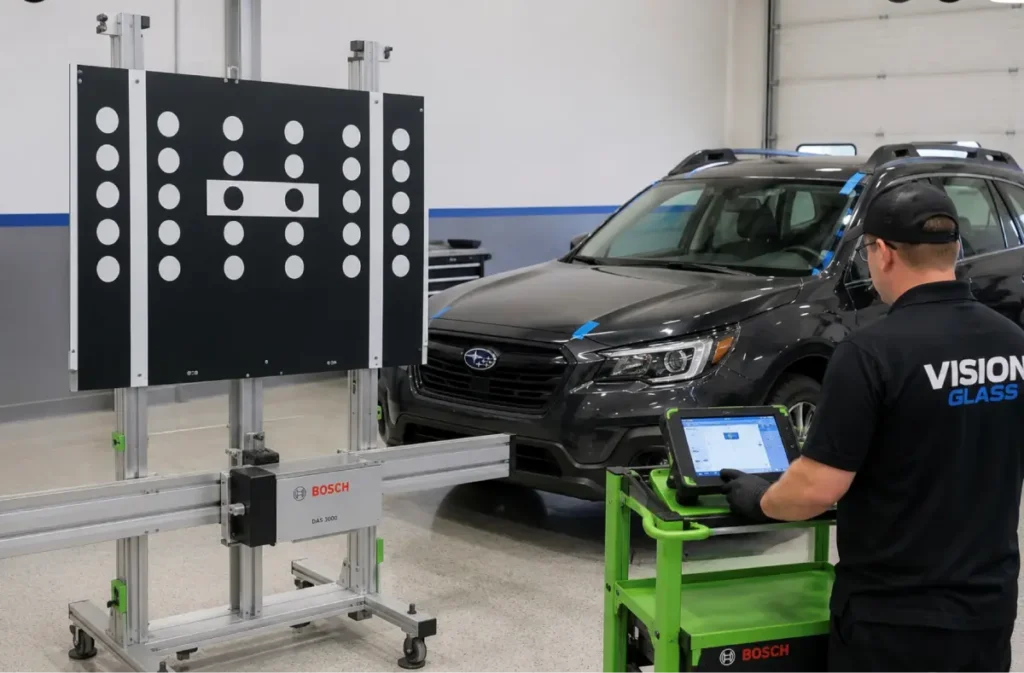
A proper calibration is not simply clearing fault codes or resetting warning lights. It requires specialized equipment, manufacturer-approved procedures, and communication with your vehicle’s onboard computer.
Calibration equipment is sophisticated and expensive, and conditions such as level ground, and lighting need to be to specification. This is why Vision Glass Toronto only perform calibrations at their shop locations where conditions can be carefully controlled.
Every calibration includes a pre-drive and post-drive test to confirm the systems are preforming properly before and after the calibration process.
Can a vehicle loose its calibration?
Yes.
If a cars battery has been boosted, replaced or the battery is not holding a consistent charge, your calibration can be affected. Also, like any other electrical components, cameras and sensors can malfunction. Even if it worked before, If your vehicle fails a calibration, you may need to replace faulty components. This can be expensive. It is IMPORTANT TO KNOW that malfunctioning hardware is considered wear and tear, and is generally NOT covered under your Insurance, nor by any Vision Glass Toronto warranty.
Why Choose Vision Glass Toronto?
At Vision Glass Toronto, your safety comes first.
Our experienced technicians determine whether your vehicle actually requires calibration, explain the process clearly, and perform manufacturer-recommended procedures using professional calibration equipment upon your approval.
We never recommend services you don’t need—but when your vehicle requires calibration, we make sure it’s done properly so your ADAS safety systems can perform as designed.
Whether you’re replacing a windshield on a vehicle with or without ADAS, you can trust Vision Glass Toronto for honest advice, quality workmanship, and a commitment to keeping you safe on the road.